Understanding Steel Target Stands: What's the Safest Way to Mount Steel Targets?
Steel targets transform shooting practice from mundane to engaging; but only when mounted correctly. Every year, shooters sustain preventable injuries from improper steel target mounting that send bullet fragments back toward the firing line. Securing your steel targets correctly can mean the difference between safe training and an unexpected visit to the emergency room.
Steel target mounting isn't just about holding a piece of steel upright. Proper mounting systems control critical safety factors: target angle, stability under impact, and the direction of bullet splash. A target that tilts forward at 10-20 degrees deflects fragments downward into the ground rather than back toward shooters. Static mounting methods that hold targets rigidly perpendicular to the shooter create dangerous rebound zones.
The mounting system you choose determines minimum safe shooting distances, compatible calibers, and target longevity. Strap/Chain-mounted systems allow targets to swing freely upon impact, dissipating energy that would otherwise create violent splash back. T-post installations offer simplicity but require careful angle adjustment. Portable stands provide flexibility for training scenarios but demand proper weight distribution or staking to prevent tip-over under repeated hits.

Understanding these fundamentals is the foundation of responsible steel target use. Training accidents from improperly mounted steel targets are entirely preventable when shooters respect the physics of bullet impact and select appropriate mounting hardware for their specific application.
Common Steel Target Mounting Systems
The shooting community relies on four primary mounting systems for AR500 targets, each suited to different training scenarios and ranges. Fixed stands dominate permanent facilities, while portable systems serve dynamic training environments. A T-post mount is designed to fit securely on a T-post and offer field-expedient solutions, and chain or strap suspension provides the most versatile option for various target sizes.
Fixed target stands use heavy-duty metal bases with vertical support posts. These systems anchor directly to concrete pads or use stakes to secure them to the ground for stability. Commercial ranges favor this approach because stands maintain consistent positioning and withstand thousands of rounds without adjustment.
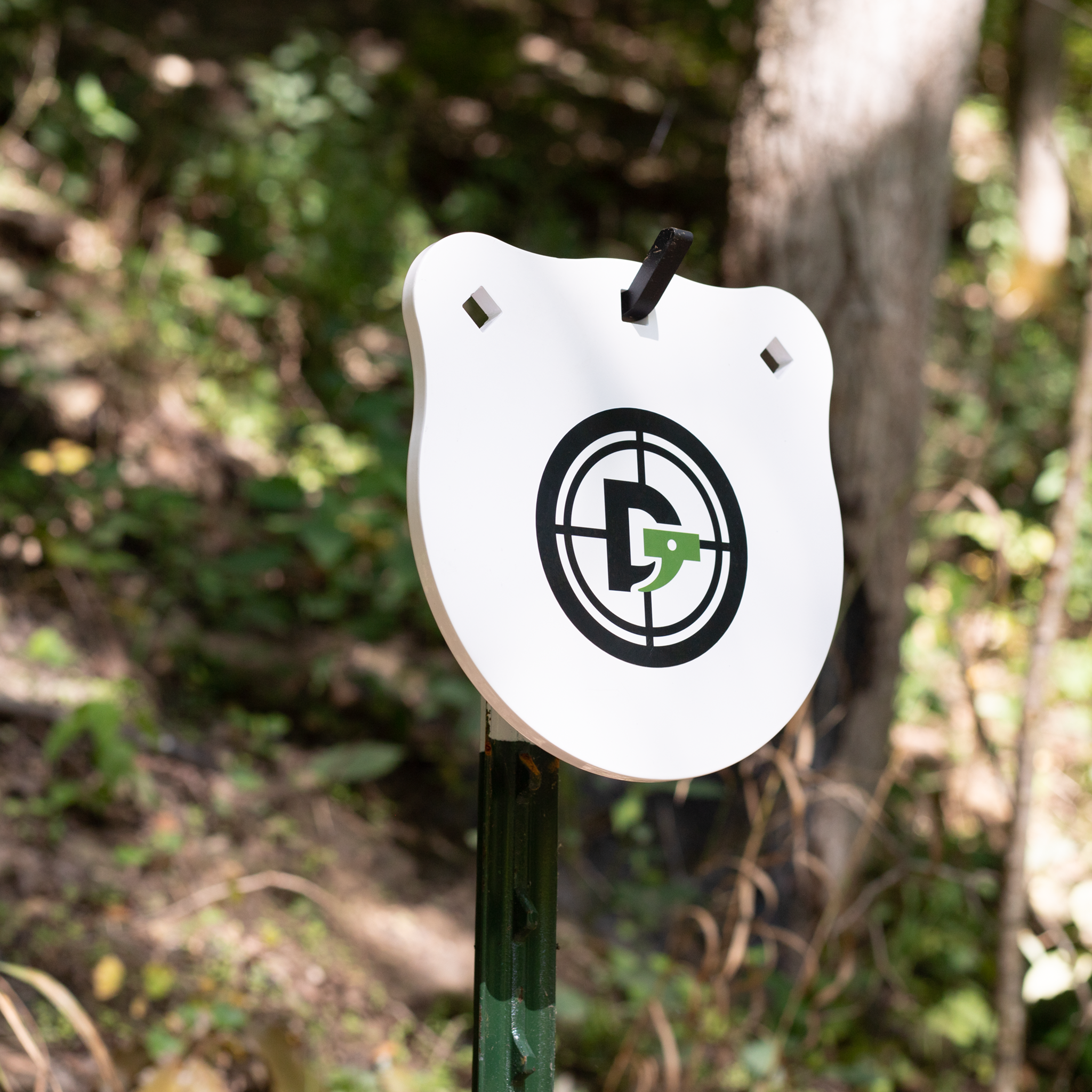
T-post mounting appeals to shooters who need economical, semi-permanent installations. Standard fence posts drive into ground and accept specialized brackets. However, this method limits angle adjustment—a critical factor for splash control.

Chain and strap suspension systems allow targets to swing upon impact, dissipating energy that would otherwise stress mounting hardware. Straps/Chains prevent ricochet fragments from traveling upward by permitting the target to rock away from the shooter. The movement also provides immediate visual feedback.
Portable stands combine lightweight construction with quick setup. These folding systems suit competitive shooters and training instructors who transport equipment between locations. Check out Double Tap Industries selection of target stands for your next shoot. Our popular kits allow you to construct portable stands using 2×4s or conduit.
Ammo Caliber Chart and Recommended Shooting Distances
Distance requirements vary dramatically based on ammunition type and target construction. Pistol calibers like 9mm and .45 ACP require minimum distances of 10 yards for safe engagement on proper steel target stands, while rifle rounds demand significantly greater standoff. Double Tap Industries recommends 100 yards minimum for .308 Winchester and similar centerfire rifle cartridges when engaging AR500 steel.
The relationship between caliber and distance is direct. High-velocity rounds generate explosive splash-back patterns when they fragment on impact. A .223 Remington traveling at 3,000 feet per second creates a 180-degree fragmentation cone that extends outward from the impact point. Shooters standing too close face direct exposure to hot copper and lead particles traveling at hundreds of feet per second.
Magnum rifle cartridges require even more conservative spacing. The Double Tap Industries ammo caliber chart helps you verify your specific ammunition against manufacturer distance charts before establishing firing positions.
Safety and Performance of Mounting Systems
Each mounting configuration affects steel target safety differently, with critical implications for shooter protection and equipment longevity. Fixed stands offer maximum stability but concentrate impact stress on mounting hardware, while hanging systems distribute energy through motion; reducing both target damage and ricochet risk. Chain-mounted targets create optimal bullet deflection patterns because they swing freely, directing splatter downward rather than back toward the firing line.
T-post systems are excellent solutions, but shooters must ensure the T-post is installed at an angle that allows for safe shooting. Research shows that targets mounted at 10–20 degrees forward tilt perform significantly better at managing bullet splash. Strap-mounted configurations excel in remote locations but require frequent tension checks as loose straps allow targets to bounce backward, creating dangerous deflection angles.
The safest mounting systems share three characteristics: they allow controlled movement, maintain consistent forward angles, and use breakaway hardware that fails before catastrophic damage occurs. Understanding these performance differences guides selection based on your specific training environment and ammunition types.
How Mounting Angle Reduces Bullet Splash
The forward angle of steel targets—typically 10-20 degrees from vertical—represents the most critical safety feature in target design. Proper angling redirects bullet fragmentation downward into the ground rather than back toward the shooter. Without this angle, fragments travel in unpredictable patterns at velocities exceeding 200 feet per second.
Portable steel target stands achieve optimal angles through adjustable leg geometry or welded base designs. Fixed stands commonly incorporate a permanent 15-degree lean, while chain-hung systems rely on gravitational pull to maintain angle consistency. However, chain-mounted targets lose effectiveness as they swing—a struck target perpendicular to the shooter creates dangerous splash patterns regardless of original positioning.
The relationship between angle and caliber intensity matters. Higher-velocity rounds require more aggressive angles to ensure downward deflection. A 10-degree forward tilt should be the minimum angle for all calibers. The physics remains straightforward: steeper angles create longer deflection paths, transforming horizontal energy into vertical momentum. Shooters who ignore angle specifications risk ricochets that defeat even proper distance protocols.
Common Steel Target Mounting Mistakes
The most dangerous mounting errors eliminate the forward angle that deflects bullets downward. Vertical or backward-leaning targets create ricochet patterns that send fragments directly toward shooters—a configuration that accounts for most steel target injuries.
Mounting targets too low represents another critical mistake. Ground-level placement causes bullet fragments to deflect horizontally across the range rather than into the dirt. The optimal height positions targets so fragments angle downward into an impact zone several feet in front of the steel.
Rigid mounting systems pose issues because they fail to absorb impact efficiently. The ideal solution is to use mounts specifically designed for T-posts. These mounts should feature either a spring behind the target to dissipate energy or a hook design that allows the target to move upon impact.
Chains or straps that are too short hinder proper target movement. These limited mounting systems restrict the backward swing needed to dissipate energy, causing mounting hardware to absorb excessive impact force. For pistol-rated targets, a minimum chain length of 12-24 inches is recommended.
Steel Target Safety Best Practices
Beyond selecting the right mounting system, consistent safety protocols prevent injuries and equipment damage. The mounting angle remains the foundation, maintain 10-20 degrees forward tilt regardless of your chosen system.
Minimum distance requirements vary by caliber. Centerfire rifles demand 100+ yards, while handguns require 10-15 yards minimum. However, distance alone doesn't guarantee safety—inspect targets before each session for cracks, dents, or pitting that create unpredictable fragment patterns.
Pre-shooting target inspection catches critical issues. Look for surface damage exceeding 1/8 inch deep, hanging systems showing wear, or mounting hardware that's loosened. A cracked or deeply pitted steel target behaves like a broken mirror—it scatters fragments in multiple directions rather than a predictable downward path.
Establish a safety buffer zone of at least 15 feet on either side of targets, as lateral splash-back occurs even with proper forward angle, particularly with rifle rounds. No shooters, range officers, or equipment should ever be down range during live fire.
Finally, match ammunition to target specifications. Using high-velocity rifle rounds on targets rated only for handgun calibers creates catastrophic failure points where the steel can't absorb impact energy properly.
Choosing Safe Steel Targets and Mounting Systems
Understanding how to mount steel targets starts with selecting equipment that integrates proper materials, thickness, and mounting compatibility. The target material itself determines what mounting systems will function safely—AR500, AR550 or SR500 steel provides the hardness necessary to prevent damage, but only when paired with appropriate hardware that maintains the critical forward angle.
Target thickness varies based on intended use: 1/4-inch AR500 is suitable for Rimfire ammunition, and 3/8-inch AR500 accommodates most handgun calibers and standard rifle rounds at customary distances, while 1/2-inch AR500 steel becomes necessary for High Caliber rifle applications. However, thickness alone doesn't guarantee safety—the mounting system must keep these specifications functional under repeated impacts.
When evaluating complete target setups, verify that mounting hardware maintains a 10-20 degree forward angle regardless of the stand type. Portable systems should include adjustment mechanisms that preserve this angle on uneven terrain. Chain-hung targets require swivel connections that prevent binding, while static mounts need angle-adjustment capabilities built into the base structure.
Pre-assembled target systems eliminate guesswork but cost more than component purchases. Building custom setups allows precise angle control and caliber-specific configurations, but demands understanding of proper hardware specifications. Either approach works safely when the forward deflection angle remains constant and target material meets minimum hardness standards.
Example Scenarios: Applying Best Practices
Understanding the safest way to mount steel targets becomes clearer when examining real-world applications. Consider a pistol range setting up multiple targets for training drills: mounting AR500 plates at a 10-degree forward angle on chain hangers positioned 10 yards back meets safe distance guidelines for 9mm and .45 ACP rounds. The angled plates direct splatter downward, while the chains allow targets to swing freely and absorb impact energy.
For rifle shooters, a different approach applies. A T-post setup works well at 100 yards for .308 caliber practice—but only when the steel thickness matches the threat (minimum 3/8-inch AR500) and the mounting brackets create that critical downward angle. Mounting the post at a 10-degree forward angle is an effective method to achieve the desired angle naturally, without the need for specialized hardware or brackets designed with an inherent angle.
What typically happens when shooters skip these considerations? Common steel target mounting mistakes include placing targets too close for the caliber being fired and using vertical mounting that directs fragments toward the shooter rather than the ground.
Where to Look Next for Reliable Sources
Understanding steel target mounting systems requires staying current with evolving safety standards and manufacturer recommendations. The foundational resource remains the National Rifle Association's range development guidelines, which address mounting configurations and minimum safety distances. Access the NRA RANGE DESIGN AND RANGE SAFETY HANDBOOK link here.
Manufacturers typically offer detailed mounting specifications for each target system to ensure safety and functionality. For instance, Double Tap Industries not only provides these specifications but also offers a wealth of information on secure mounting practices. Their designs often incorporate adjustable bases and mounts, which enable users to precisely set the appropriate mounting angles for optimal performance and safety. This flexibility ensures that targets can be aligned correctly to accommodate various shooting scenarios, enhancing both accuracy and safety during use.
Key Takeaways
-
Steel target mounting systems are crucial for shooter safety and target longevity.
-
The safest setup includes proper mounting hardware, correct angles, and suitable shooting distances.
-
Chain or strap mounting allows targets to swing freely, directing bullet splash downward rather than back toward shooters.
-
A 10-20 degree forward tilt reduces ricochet risk when targets are mounted rigidly.
-
Minimum safe distances vary by caliber: seven yards for handguns and over 100 yards for high-velocity rifles.
-
Use AR500, AR550, or SR500 steel rated for your specific ammunition to ensure safety.
-
Proper mounting execution is essential to translate the steel rating into actual safety.
-
Before your next range session, ensure your mounting system allows target movement, check for wear on connection points, and confirm distances match your ammunition type.
-
Steel target training provides immediate feedback and realistic engagement, but only when mounted correctly from the start.